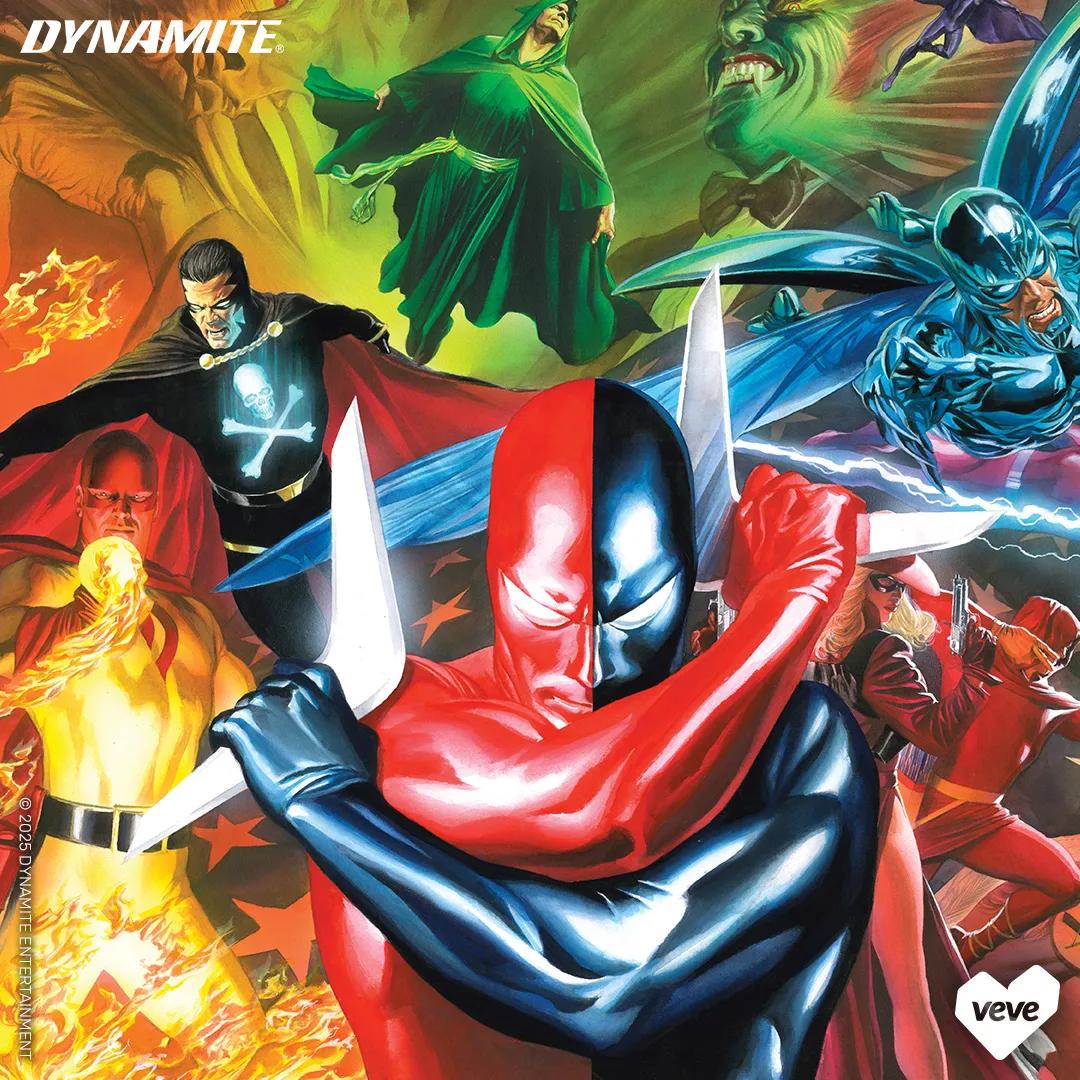
Reading The Twelve, Band of Heroes and The Marvel Project (not to mention the series in the "Miscellaneous New Universes" thread) recently really put me in the mood to read Project Superpowers. Unfortunately, I had no idea where I had filed it. Rather than look for it, I simply waited to discover it naturally, while looking for something else, which I did yesterday. Project Superpowers is Alex Ross and Jim Krueger's examination of Golden Age superheroes in the public domain. (New adventures of some of them can be found at other publishers as well.) It was initially presented in two "chapters," the first being eight issues (#0-7) and the second being 13 (#0-12). I read the first couple of issues of "Chapter One" and planned to read it in a single sitting at a later date, but when #7 shipped and I realized I had missed #6, I dropped it. I'm in the mood now, though, and have acquired a copy of #6. Here's a look at what's ahead.
- Airman
- Amazing Man
- American Crusader
- American Eagle
- The Arrow
- Atoman
- Big Blue [the Blue Beetle] (& Sparky)
- The Black Owl
- The Black Terror (& Tim)
- Black Venus
- Blue Bolt
- The Boy King (& his Giant)
- Captain Battle (& Captain Battle Jr.)
- Captain Courageous
- Captain Future
- The Cat[man] (& Kitten)
- The Crusaders
- Cyclone
- The Dart & Ace
- The Death-Defying [Dare]Devil
- Doc [Strange]
- Dynamic Man (& the Dynamic Family)
- The Fighting Yank
- The Flag
- The Flame (& Flame Girl)
- Golden Lad
- The Green Giant
- The Green Lama
- The Green Mask (& Domino)
- The Grim Reaper
- The Hood
- The Holy Terror
- Hydro
- Jack
- Lash Lightning (& Lightning Girl)
- The Liberator
- Man Of War
- Man O'Metal
- Masquerade
- Major Victory
- Marvelo
- Mr. Face
- Mr. Raven
- The Owl
- Phantasmo
- Pyroman
- Radior
- Rainbow Boy
- Rocketman (& Rocketgirl)
- The Mighty Samson (& David)
- Silver Streak
- Skyman
- Sparkman
- Strongman
- Sub-Zero Man
- Super-American
- The Sword
- The Target (& the Targeteers)
- The Unknown Soldier
- U.S. Jones
- V-Man (& the V-Boys)
- Vulcan
- The Woman in Red
- Yank & Doodle

Replies
The "zero" issue of Project Superpowers is told from the point of view of Bruce Carter III, the Fighting Yank.
The Fighting Yank first appeared in Startling Comics #10. Bruce Carter III was a special agent under a secret commission of the OSS. He was made steward of a cloak of unlimited power and is guided by the ghost of his ancestor, a Revolutionary War soldier. One of the Fighting Yank's stories (from Startling Comics #32) can be found in IDW's Super Patriotic Heroes, edited by Craig Yoe.
Reading Project Superpowers #0 is an experience not unlike that of reading The Twelve #1, but instead of following a group of obscure Golden Age WWII heroes at the defeat of Germany, it follows a group of obscure Golden Age heroes at the defeat of Japan. The Fighting Yank discovers that Pandora's mythical box is actually an urn. Over the course of thousands of years, the Evil that was released from it was eventually drawn back in. The Yank has come to believe that Hitler found the urn and re-released Evil into the world. The Hope that was released with it took the form of masked costume adventurers. The only way to shorten the process, Carter believes, is if the Good, the heroes, surrender their essence into the urn to ensure that the Evil is ensared as well.
The problem is, the heroes don't believe him. So the Fighting Yank ambushes The Flame to jumpstart the process. The war comes to an end, but over the course of the next several years, the Fighting Yank continues to snatch the essense of other heroes to safeguard against the Evil. By this time, the Green Lama had returned to Tibet. (Because the creatures know him now, Carter himself can never be part of the Hope trapped within the urn because he could never take them unaware.) Another problem is that he was wrong about the whole thing. He had been misled by his Spirit Guide. Decades later, the world is filled with more Evil than ever.
Now an old man in the twilight of his life, Bruce Carter has been sent on one last mission. Along with the ghost of his ancestor and the newly formed American Spirit, the Yank heads to Shagri-La to recruit the help of his former ally, the Green Lama, in his quest to free his fellow heroes from the Urn of Pandora.
I remember this! Mainly, I remember it as a great idea poorly executed.
At the time, I had no idea who most of these characters were. Some of them seemed so preposterous that it was hard to believe they had actually existed. Oh, I was so young and innocent! Yes, they did indeed exist, and they were just as preposterous in the Golden Age as they are now.
Thanks for pointing out where names currently in use elsewhere had to be changed, like [Dare]Devil and Big Blue [Beetle].
I wasn't thrilled with the storyline, because I can't believe anyone would ambush and imprison their friends on a theory. And the theory is, basically, "the only way to beat this great team is to take our best players off the field." Say what now? It's hard to believe anyone could be that dumb.
You know, the only other thing I remember Jim Kreuger's name attached to was Earth-X, which I also hated as being more gimmick than plausible story. There's a pattern forming here.
I don't remember how far I got into Project Superpowers. I will read your summaries avidly to find out. And even more avidly when you pass where I gave up.
Yes, they did indeed exist, and they were awful.
The fact that these characters did exist somehow "legitimizes" the premise for me (as it did with The Twelve), and I plan to hit the characters' GA origins as much as the series' plot.
Some of them seemed so preposterous that it was hard to believe they had actually existed.
Some can be found in Super Weird Heroes (also from IDW/Craig Yoe).
You know, the only other thing I remember Jim Kreuger's name attached to was Earth-X...
Don't forget Justice (another gimmick). Hmm...
Oh, there was Avengers/Invaders, too.
That was a good one.
The fact that these characters did exist somehow "legitimizes" the premise for me (as it did with The Twelve), and I plan to hit the characters' GA origins as much as the series' plot.
I'm looking forward to it. I'm no longer as young and innocent as I was, but I'm also not as judgmental. I will take these stories as seriously as I can, even if I am currently looking at a cover with a guy fighting World War II in colonial garb. (I don't think the shoes, in particular, are very practical for 20th century combat.) Even Alex Ross can't make that look convincing.
The "F" Troop
"The end of the Civil War was near when quite accidentally..."
I have the first PROJECT SUPERPOWERS trade paperback and I remember being pretty excited about it. Of course, it's a depressing read, considering the time period it was published.
I had some problems with the art. It looked like everyone had huge foreheads! And it was murky in places!
In trying to modernize these characters, they lost whatever corny charm they had.
I read about most of these public domain heroes in Jeff Rovin's extensive though slightly flawed The Encyclopedia of Superheroes. And Roy Thomas used many of them with different names in his Alter Ego comic book and Alan Moore annexed them into Tom Strong and Terra Obscura where Doc Strange, called just Doc in Project Superpowers, was now Tom Strange, a counterpart to Tom Strong.
Even Americomics revived the Black Terror in the early 80s!
ISSUE #1 - The Green Lama & Black Terror:
Bruce Carter makes he way to Shangri-La with his two spirit guides in tow. He is greeted by Tsarong, Jethro Dumont's former manservant, and ushered into the presence of the Green Lama, who has not significantly aged in all these years. Carter tells Dumont what he has done, and fully expects to be killed by him, but the Green Lama instead agrees to help Carter in his quest to free their old friends. Pandora's urn in now in the posession of Curt Cowan, the Dynamic Man. Cowan is one of the few heroes not contained within the urn, and runs a multi-national conglomerate, Dynamic Forces.
Carter breaks the urn, expecting his former friends to be freed, but nothing happens. Dynamic Man reveals that he had all magic removed from the urn, then he turns on his two former allies. But at least one soul was freed from the urn, Black Terror, and his is pissed! He does plan to kill Bruce Carter, but ends up embroiled in the conflict against Dynamic Man instead. Dynamic Man is revealed to be a robot.
THE GREEN LAMA:
"Years of study in far-off Tibet, the home of magic, enables wealthy young Jethro Dumont to become the owlrds greatest crime fighter -- the man of strength -- The Green Lama! It was the ancient lamas of Tibet who discovered that a man who had devoted his life to meditation could gain super-human strength and power through the words Om Mani Padme Hum."
Green Lama reminds of Jack Burnley's Starman in that the artwork, by Mac Raboy, far outshines the story. Having said that, though, the stories themselves are quite progressive for 1944, breaking new ground with their near-deification of Tibetans and Tibetan religious orders. Also, Jethro's man Tsarong is much more a valued counselor than he is a servant. There is one question that must be answered by every comic book fan of a "certain age," namely: "What's your favorite Raboy?" The 21st century being the true "Golden Age of Comics," it is now easier to answer this question first hand than before. Having read (reprints of) his Green Lama, Captain Marvel Junior and Flash Gordon for myself, with my own eyes, I can enequivocally state that, as good as he was at the beginning of his career, he continued to improve his skills throughout the rest of his life. The entire eight-issue run of Spark Publications' Green Lama is available in two volumes of Dark Horse's Green Lama Archives.
BLACK TERROR:
Bob Benton was a phamacist working on a tonic to pep people up, but he developed "formic ether" instead, due a his assistant, Tim Roland, accidentally adding formic acid (from red ants) into the mix. Inhaling the vapors granted him superhuman strength, which he used to become the Black Terror, battling hoodlums, saboteurs and enemy agents in equal measure. Tim became his sidekick; Jean Starr is his romantic interest; Rodney Clark his rival. Black Terror was the most popular of standard's early heroes, featured in his own eponymous title and America's Best Comics as well as Exciting Comics. He lasted through 1949 when all three titles were cancelled. Today the Black Terror can be found in three volumes from PS Artbooks.
DYNAMIC MAN:
Also featured in #1 (and in the background of the cover) is Dynamic Man, but a quite different version than appeared in Marvel's The Twelve. This one is like a cross between Alan Moore's Ozymandias and Alan Moore's Miracleman. His Golden Age adventures can be found in the Marvel Masterworks volume of Mystic Comics, and as I have already mentioned, Marvel revived a different version of this character in The Twelve.
I don't recall at what point I stopped reading Project Superpowers back in 2008, but it really doesn't matter because I'm not remembering any of this. I'm really digging it now, though,. I have no trouble imagining an Earth in which "The Twelve" disappeared from Germany at the end of WWII and the "Project Superpowers" group from Japan. I am also enjoying supplementing my reading with at least one each of the Golden Age comics I've mentioned for every character.
Visually, Roy Thomas based Mister Bones on the Black Terror!
Green Lama reminds of Jack Burnley's Starman in that the artwork, by Mac Raboy, far outshines the story. Having said that, though, the stories themselves are quite progressive for 1944.
I got those Dark Horse collections when they came out, and remember being impressed with the artwork. I don’t remember much about the stories, which reinforces your point that the art was stronger.
Bob Benton was a pharmacist working on a tonic to pep people up, but he developed "formic ether" instead, due a his assistant, Tim Roland, accidentally adding formic acid (from red ants) into the mix.
He should have called himself Ant-Man! Or at least Red Terror.
I’ve read the first of the three PS Artbooks. I was really looking forward to it, because from the name and (impressive) costume, I assumed he’d be a dark avenger type, and played as a scary, lethal type. But IIRC, he was just a standard Golden Age costumed hero (albeit with super-strength). Was he bullet-proof, too? I don’t remember.
Anyway, I didn't hate Black Terror, but I wasn’t impressed enough to read the next one right away. I will eventually.
Also featured in #1 (and in the background of the cover) is Dynamic Man, but a quite different version than appeared in Marvel's The Twelve.
That’s because he’s a different character! At least technically.
Marvel’s Dynamic Man debuted in Mystic Comics #1 in January 1940, an android in a green-and-yellow costume. Chesler/Dynamic’s Dynamic Man debuted in Dynamic Comics #1 in October 1941, an android in a green-and-yellow costume (with a red cape, boots and gloves). The latter is the one in public domain, and appears in Project: Superpowers.
The similarity is so strong that I think it very likely that Harry Chesler basically swiped the character. Marvel’s version only appeared in four issues, with the last cover dated August 1940. Dynamic’s version appeared more than a year later. Maybe Chesler hoped Marvel wouldn’t notice or care. There’s probably a story there that I will never know.
Every source I find online says Chesler gave Dynamic Man a second origin, as high school coach Bert McQuade, who had been given “treatments” by a Professor Stahl that gave him super-powers. The same was done with sidekick Ricky, the Dynamic Boy. I searched for that and found it piecemeal.
Dynamic Comics ended (temporarily) with issue #3 in February 1942. It returned two years later, with Dynamic Comics #8 (issues #4-7 don’t exist), with a reprint of Dynamic Man’s robot origin from issue #1.
Ricky appeared with no fanfare (as if he’d always been there) in issue #11 (September 1944). Dynamic Man referred to him as his “young pal,” but later issues established Ricky is Dynamic Man’s kid brother. The high school Coach McQuade angle (with Ricky still his brother, and a student at the same high school) was introduced in Dynamic Comics #15 (July 1945) — once again, as if that had always been the case. In Dynamic Comics #16 (October 1945), Dynamic Man mentions “the complex electronic treatments” given to them by “old Doc Stahl … and Doc is dead.”
Dynamic Man continued in Dynamic Comics until its cancellation with issue #20 (October 1946). As you can tell from the cover dates, issues were released somewhat erratically toward the end.
Canada’s Superior Comics picked up the series in 1947, with issues #21-24 and 30. (Once again, there are skipped issues.) Dynamic Man appeared in issues #21-24. So Chesler’s Dynamic Man had 17 original stories in his 20-issue run, as opposed to Marvel’s Dynamic Man, who appeared only four times in the Golden Age. He lay fallow until resurrected for The Twelve.
I don't recall at what point I stopped reading Project Superpowers …
I don’t recall when I stopped reading, either, but I read farther than this. In fact, I think we’re going to be introduced pretty soon to Dynamic Boy … and Dynamic Woman!
-
1
-
2
-
3
-
4
-
5
of 8 Next